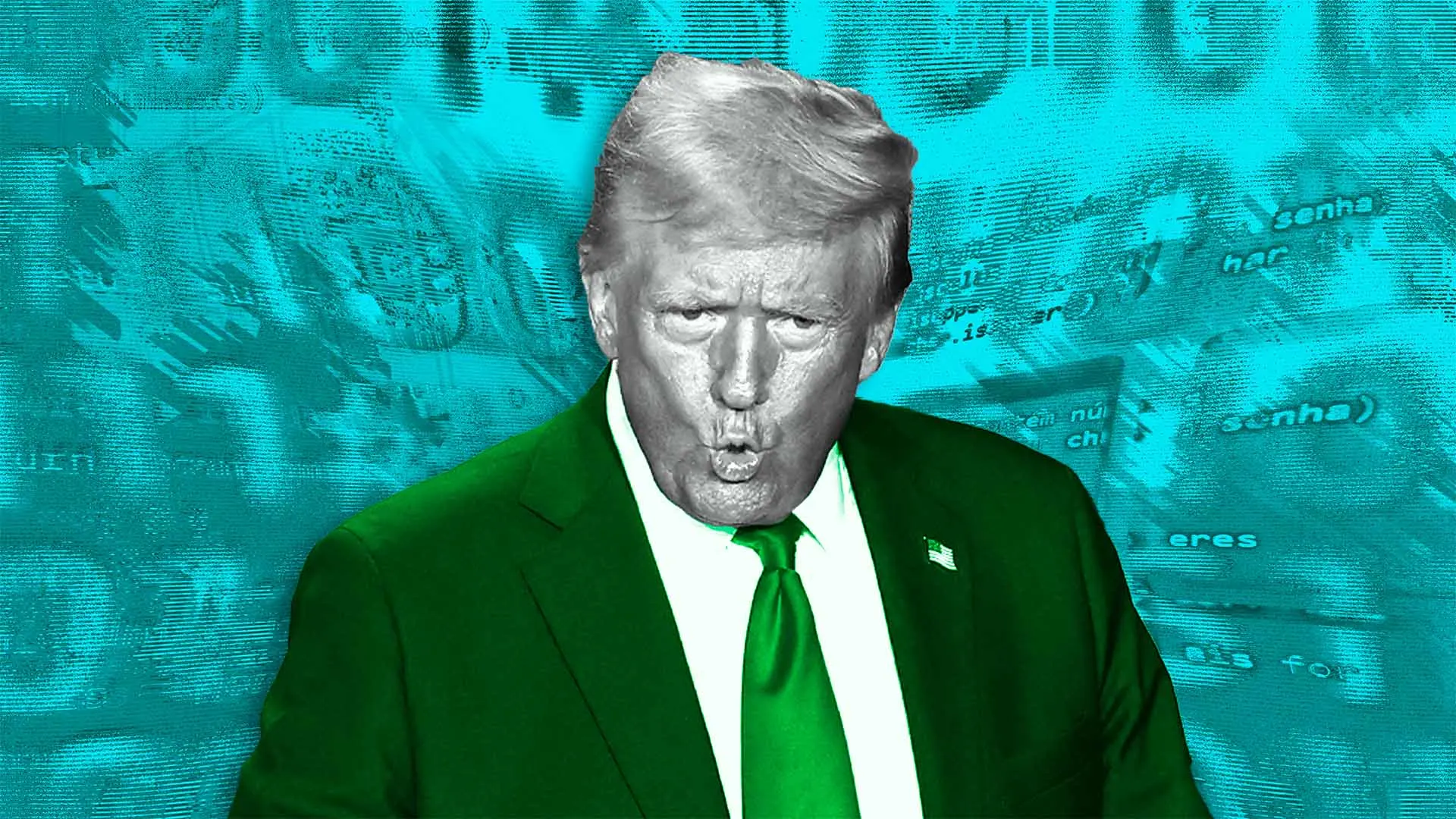

Former President Donald Trump has introduced a new artificial intelligence initiative that places a strong emphasis on limiting federal regulations and addressing what he describes as political bias within AI systems. As the use of artificial intelligence rapidly expands across various sectors—including healthcare, national security, and consumer technology—Trump’s approach signals a departure from broader bipartisan and international efforts to apply tighter oversight over the evolving technology.
Trump’s newest proposition, integral to his comprehensive 2025 electoral strategy, portrays AI as a dual-faceted entity: a catalyst for American innovation and a possible danger to free expression. At the core of his plan is the notion that governmental participation in AI development should be limited, emphasizing the need to cut down regulations that, according to him, could obstruct innovation or allow ideological domination by federal bodies or influential technology firms.
Aunque otros líderes políticos y organismos reguladores en todo el mundo están desarrollando marcos orientados a garantizar la seguridad, transparencia y uso ético de la inteligencia artificial (IA), Trump está presentando su estrategia como una medida correctiva frente a lo que considera una creciente interferencia política en el desarrollo y uso de estas tecnologías.
At the heart of Trump’s plan for AI is a broad initiative aimed at decreasing what he perceives as excessive bureaucracy. He suggests limiting federal agencies’ ability to utilize AI in manners that may sway public perspectives, political discussions, or policy enforcement towards partisan ends. He contends that AI technologies, notably those employed in fields such as content moderation and monitoring, can be exploited to stifle opinions, particularly those linked to conservative perspectives.
Trump’s plan indicates that any employment of AI by federal authorities needs examination to guarantee impartiality, and no system should be allowed to make decisions that could have political consequences without direct human monitoring. This viewpoint is consistent with his persistent criticisms of governmental bodies and major tech companies, which he has often alleged to lean towards left-wing beliefs.
His plan also includes the formation of a task force that would monitor the use of AI within the government and propose guardrails to prevent what he terms “algorithmic censorship.” The initiative implies that algorithms used for flagging misinformation, hate speech, or inappropriate content could be weaponized against individuals or groups, and therefore should be tightly regulated—not in their application, but in their neutrality.
Trump’s AI platform also zeroes in on perceived biases embedded within algorithms. He claims that many AI models, particularly those developed by major tech firms, have inherent political leanings shaped by the data they are trained on and the priorities of the organizations behind them.
While researchers in the AI community do acknowledge the risks of bias in large language models and recommendation systems, Trump’s approach emphasizes the potential for these biases to be used intentionally rather than inadvertently. He proposes mechanisms to audit and expose such systems, pushing for transparency around how they are trained, what data they rely on, and how outputs may differ based on political or ideological context.
Her proposal does not outline particular technical methods for identifying or reducing bias; however, she suggests the creation of an autonomous entity to evaluate AI tools utilized in sectors such as law enforcement, immigration, and digital interaction. She emphasizes that the aim is to guarantee that these tools remain “unaffected by political influence.”
Beyond concerns over bias and regulation, Trump’s plan seeks to secure American dominance in the AI race. He criticizes current strategies that, in his view, burden developers with “excessive red tape” while foreign rivals—particularly China—accelerate their advancements in AI technologies with state support.
To address this, he proposes tax incentives and deregulation for companies developing AI within the United States, along with expanded funding for public-private partnerships. These measures are intended to bolster domestic innovation and reduce reliance on foreign tech ecosystems.
En cuanto a la seguridad nacional, la propuesta de Trump carece de detalles, aunque reconoce el carácter dual de las tecnologías de IA. Promueve tener un control más estricto sobre la exportación de herramientas de IA cruciales y propiedades intelectuales, especialmente hacia naciones vistas como competidores estratégicos. No obstante, no detalla la forma en que se aplicarían tales restricciones sin obstaculizar las colaboraciones globales de investigación o el comercio.
Interestingly, Trump’s AI strategy hardly addresses data privacy, a subject that has become crucial in numerous other plans both inside and outside the U.S. Although he recognizes the need to safeguard Americans’ private data, the focus is mainly on controlling what he considers ideological manipulation, rather than on the wider effects of AI-driven surveillance or improper handling of data.
The lack of involvement has been criticized by privacy advocates, who claim that AI technologies—especially when utilized in advertising, law enforcement, and public sectors—could present significant dangers if implemented without sufficient data security measures. Opponents of Trump argue that his strategy focuses more on political issues rather than comprehensive management of a groundbreaking technology.
Trump’s AI agenda stands in sharp contrast to emerging legislation in Europe, where the EU AI Act aims to classify systems based on risk and enforce strict compliance for high-impact applications. In the U.S., bipartisan efforts are also underway to introduce laws that ensure transparency, limit discriminatory impacts, and prevent harmful autonomous decision-making, particularly in sectors like employment and criminal justice.
By advocating a hands-off approach, Trump is betting on a deregulatory strategy that appeals to developers, entrepreneurs, and those skeptical of government intervention. However, experts warn that without safeguards, AI systems could exacerbate inequalities, propagate misinformation, and undermine democratic institutions.
The timing of Trump’s AI announcement seems strategically linked to his 2024 electoral campaign. His narrative—focusing on freedom of expression, equitable technology, and safeguarding against ideological domination—strikes a chord with his political supporters. By portraying AI as a field for American principles, Trump aims to set his agenda apart from other candidates advocating for stricter regulations or a more careful embrace of new technologies.
The proposal also reinforces Trump’s broader narrative of fighting against what he describes as an entrenched political and technological establishment. AI, in this context, becomes not just a technological issue, but a cultural and ideological one.
The success of Trump’s AI proposal largely hinges on the results of the 2024 election and the composition of Congress. Even if some elements are approved, the plan will probably encounter resistance from civil liberties organizations, privacy defenders, and technology professionals who warn against a landscape where AI is unchecked.
As artificial intelligence advances and transforms various sectors, nations globally are striving to find the optimal approach to merge innovation with responsibility. Trump’s plan embodies a definite, albeit contentious, perspective—centered on reducing regulation, skepticism towards organizational supervision, and significant apprehension about assumed political interference via digital technologies.
What we still don’t know is if this method can offer the liberty alongside the protections necessary to steer AI progress towards a route that rewards society as a whole.